Personalized Medical Care & Dedicated International Patient Concierge

Medical Guide
Full Mouth Reconstruction Cost & Timeline: Phased Quotes
Understand full mouth reconstruction cost Korea factors and phased bite reconstruction timelines with Dr. Hanna Lee at Harue Dental Clinic in Gangnam.
Schedule a ConsultationFull Mouth Reconstruction Cost and Timeline: Why Complex Cases Need a Phased Quote
Medically reviewed by Dr. Hanna Lee, DDS, MSD, PhD
The Bottom Line
- Why Flat Estimates Fall Short: Evaluating full mouth reconstruction cost Korea options cannot be reduced to a sight-unseen package fee because hidden root fractures, alveolar bone resorption, and vertical bite collapse only become quantifiable after 3D radiographic and occlusal diagnostics.
- Stage-Based Financial & Clinical Architecture: Dividing a complex dental case quote into distinct phases—diagnostic stabilization, surgical foundation and provisionalization, biological healing, and final ceramic delivery—aligns fees and chair time with actual clinical milestones.
- Biological Healing Sets the Calendar: While crown- and veneer-only rehabilitations can be completed in a single visit window, cases involving dental implants require an osseointegration interval (
2 to 3 monthsfor immediate-load full-arch cases, or3 to 6 monthswhen staged bone integration is required) before permanent prostheses are locked into the bite. - Travel Window Planning: Overseas patients planning their stay duration full mouth rehab itinerary typically allocate roughly
7 to 14 daysper primary complex treatment stage in Korea, depending on the surgical and restorative scope involved. - Direct Oversight & On-Site Milling: Through Gangnam-gu's Harue Dental Clinic (Business Registration No.
211-10-45284), Representative Director Dr. Hanna Lee, DDS, MSD, PhD leads all diagnostic, surgical, and prosthetic stages supported by17digital imaging/scanning systems (12 Omnicamsand5 PrimeScans) alongside24in-house CAD/CAM milling units.
Why Sight-Unseen Package Quotes Are Unreliable for Complex Bite Rehabilitation
Patients researching full mouth reconstruction cost Korea clinics provide often try to compare treatment proposals by asking for a flat fee over email using a two-dimensional panoramic X-ray or smartphone photographs. While a straightforward single-tooth restoration has predictable parameters, full-mouth or multi-quadrant bite reconstruction involves rebuilding an entire masticatory system where teeth, gums, jawbone, and temporomandibular joints interact dynamically.
Clinical reports indexed by PubMed (maintained by the National Library of Medicine, Journal of Prosthodontics, 2014) highlight that severely worn or broken-down dentitions frequently mask underlying structural complications. A tooth that looks restorable on a flat image may harbor a vertical root crack beneath an old metal crown; an edentulous molar area may have pneumatized maxillary sinus anatomy requiring bone augmentation; or years of generalized attrition may have shortened the lower third of the face, requiring a carefully tested increase in vertical dimension before final ceramics can be fabricated (Cureus, 2023).
If a clinic quotes a rigid lump sum before performing three-dimensional cone-beam computed tomography (CBCT) and digital occlusal analysis, one of two problems typically occurs: either the estimate inflates contingencies for procedures the patient may never need, or unexpected clinical findings force mid-treatment add-ons and rushed schedule changes. At Harue Dental Clinic's Sinsa-dong center, Representative Director Dr. Hanna Lee, DDS, MSD, PhD—who brings over three decades (30+ years) of clinical practice since founding the clinic in 1995, 90,696 cumulative implant placements, and 3,000+ full-arch rehabilitations as of September 2025—structures every complex reconstruction through a transparent, phased diagnostic and treatment roadmap.
Five Clinical Variables That Shape a Phased Reconstruction Quote
Rather than guessing a single bundled figure, a diagnostic complex dental case quote breaks the restoration down into five measurable clinical components confirmed during your in-person assessment.
1. Preliminary Disease Control and Foundation Stabilization
Definitive implants, zirconia crowns, and ceramic laminates cannot be placed over active infection. Before prosthetic reconstruction begins, the clinician must evaluate whether any teeth require endodontic retreatment, periodontal therapy for gum inflammation, removal of failing bridgework, or extraction of hopeless roots. Addressing these biological prerequisites in Phase I prevents post-treatment complications and clarifies exactly how many natural teeth can serve as reliable long-term abutments.
2. Surgical Implant Scope and Bone Support Requirements
When missing or non-restorable teeth are part of the arch, the surgical scope depends on the number of implant fixtures needed, alveolar ridge width and height, and whether sinus elevation or bone grafting is required. Research published in PubMed (Clinical Oral Implants Research, 2000) demonstrates that primary implant stability in native versus grafted bone directly determines whether immediate provisional loading is viable or whether a staged submerged or non-submerged healing protocol (Journal of Clinical Periodontology, 2004) is safer.
Dr. Hanna Lee—who placed 2nd in her 1994 class at Pusan National University's dental school, completed graduate master's and doctoral degrees at The Catholic University of Korea (serving there as Adjunct Professor of Implant Dentistry), and trained surgically at Germany's University of Berlin—utilizes navigation-guided and index-guided surgical protocols (practiced since 2002 and trademarked as "Navigation Implant" in 2007), the German Ankylos implant system, and custom titanium abutments.
3. Provisional Restorations and Occlusal Vertical Dimension Testing
In cases of severe tooth wear or bite collapse, jumping straight from tooth preparation to final ceramic delivery is biomechanically risky. Peer-reviewed prosthodontic case studies on PubMed (Cureus, 2024) emphasize the importance of structured provisionalization—such as twin-stage occlusal verification—to confirm that the jaw muscles, joints, and phonetics adapt comfortably to the restored bite height. Factoring custom provisional restorations into the phased plan protects prepared teeth while giving both clinician and patient a real-world trial of the new occlusal plane.
4. Restoration Unit Mix and In-House CAD/CAM Material Selection
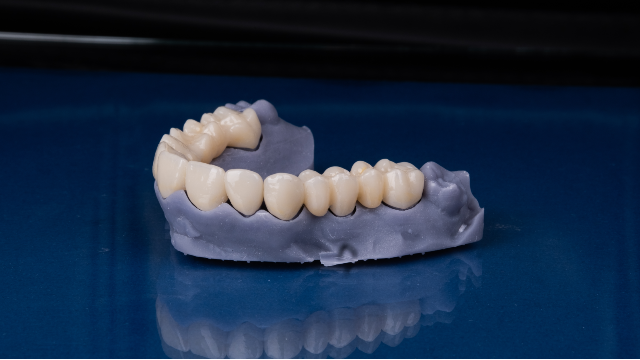
The prosthetic portion of a phased quote reflects the exact number and type of definitive units required across each arch:
- Conservative Full-Coverage Zirconia or CEREC Crowns: Used for structurally weakened or root-canal-treated teeth, requiring
0.5 to 1.0 mmpreparation while preserving pulp vitality whenever possible. High-strength CEREC all-ceramic blocks provide approximately150 MPaof flexural strength (compared with~80 MPafor conventional porcelain) and are supported by27 yearsof clinical longevity data cited in the clinic's restorative guidelines. - Minimal-Prep and No-Prep Ceramic Laminates: Used for anterior teeth with intact enamel that need proportion or guidance refinement. Applying her Korean Patent
10-1067942(2011), Dr. Hanna Lee designs minimal-prep veneers averaging~0.3 mm(versus~0.7 mmconventional reduction) and no-prep veneers at0.1 mm. - In-House Digital Laboratory Efficiency: Because Harue Dental Clinic operates
24on-site CAD/CAM milling machines and17digital scanning systems (12 Omnicamsand5 PrimeScans)—building on its2007CEREC lab launch and2008Sirona certification as Korea's highest-treatment-volume CEREC 3 clinic—prosthetic design, custom shading, and occlusal milling are coordinated internally without third-party laboratory markups or shipping delays.
5. Anesthesia, Sedation, and Post-Treatment Maintenance
Complex reconstructions combine surgical and restorative appointments of varying length. The phased plan details the specific local anesthesia or sedation options confirmed for each clinical stage, alongside postoperative follow-up checks and protective nightguard fabrication for patients who clench or grind.
Phased Quote & Timeline Architecture: Stage-by-Stage Breakdown
The table below illustrates how a staged dental restoration Seoul timeline and phased quote are organized when combining implants, crowns, and laminates at Harue Dental Clinic.
| Reconstruction Stage | Clinical Procedures Included | Typical Time Window | Why This Stage Is Quoted & Scheduled Separately |
|---|---|---|---|
| Phase I: Diagnostic & Biological Stabilization | 3D CBCT imaging, digital intraoral scans (PrimeScan / Omnicam), occlusal analysis, periodontal/endodontic stabilization, and removal of hopeless teeth |
Days 1–3 of Initial Visit |
Establishes the exact tooth-by-tooth prognosis so the patient only commits to definitive restorations on biologically sound pillars |
| Phase II: Surgical Foundation & Provisional Bite Setup | Navigation-guided or index-guided Ankylos implant placement, necessary bone grafting, tooth preparation (0.5–1.0 mm for crowns), and provisional restoration delivery |
Within a 7 to 14 day Seoul Stay Window |
Separates surgical fixture placement and temporary bite stabilization fees from final ceramic fabrication costs |
| Biological Healing Interval (When Implants Are Included) | Osseointegration of titanium fixtures with jawbone, soft-tissue maturation around healing abutments, and functional adaptation to provisional bite height | 2 to 3 months (immediate-load full-arch) or 3 to 6 months (staged healing / grafted sites) |
Biological bone remodeling (BioMed Research International, 2022) dictates when implants can safely bear final ceramic occlusal loads |
| Phase III: Definitive CAD/CAM Milling & Bite Calibration | Final digital impressions, custom titanium abutment seating, simultaneous in-house milling of zirconia/CEREC crowns and 0.1–0.3 mm laminates, bonding, and bilateral bite equilibration |
Return Visit (5 to 10 days depending on arch scope) |
Final prosthetic fees are billed when definitive ceramics are milled, shaded, bonded, and balanced across the arch |
Planning Your Stay Duration and Travel Itinerary in Seoul
For international patients coordinating flights and work leave, understanding your bite reconstruction timeline prevents rushed clinical compromises.
Scenario A: Crown and Laminate Reconstruction Without New Implants
If your posterior support is already intact—meaning you have healthy natural molars or existing stable implants—and your reconstruction involves replacing aging crowns (0.5 to 1.0 mm prep) and restoring worn front teeth with 0.1 mm no-prep veneers or ~0.3 mm minimal-prep laminates, no bone-healing interval is required. Depending on whether root canal therapy or gum recontouring is needed, non-implant reconstructions can often be completed within a single stay in Seoul, ranging from 1 to 3 days for localized CAD/CAM restorations to 7 to 14 days for multi-unit arch rehabilitation with bite verification.
Scenario B: Combined Reconstruction Including Dental Implants or Bone Grafting
When missing back teeth must be replaced with dental implants to restore vertical bite support before crowns and veneers are finalized, treatment is staged across two visits:
- First Visit to Seoul (
~7 to 14 days): Covers 3D CBCT diagnostics, preliminary extractions or periodontal care, navigation-guided implant placement, initial tooth preparations, provisional restorations, and postoperative suture/healing checks before flying home. - Osseointegration Interval at Home (
2 to 6 months): As reviewed in PubMed (BioMed Research International, 2022), osseointegration requires a biological transition from primary mechanical stability to secondary bone remodeling. Immediate-loading full-arch protocols typically require2 to 3 monthsof integration before final prosthetic conversion, whereas sites requiring bone grafting or staged healing typically require3 to 6 months. - Second Visit to Seoul: Once integration is verified radiographically, final digital scans are taken, custom titanium abutments are connected, and the clinic's
24in-house milling units fabricate the definitive zirconia crowns, CEREC restorations, and laminates for simultaneous fitting and bilateral occlusal balancing.
What to Confirm During Your Phased Quote Consultation
When reviewing your complex dental case quote and schedule with Harue Dental Clinic's scheduling team, use the checklist below to ensure every clinical and logistical detail is clear:
- Itemized Phase-by-Phase Breakdown: Ask how diagnostic stabilization, surgical implant placement, provisional restorations, and final CAD/CAM crowns/laminates are separated across your treatment phases, and confirm payment timing for each stage.
- Contingency Planning for Borderline Teeth: Ask what happens to your timeline and quote if a heavily restored tooth reveals a deeper crack or endodontic issue once an old crown is removed.
- Buffer Days Within Your Stay Window: Confirm how many follow-up bite adjustment and hygiene review appointments are built into your
7 to 14 daystay before your departure flight. - Sterilization and Surgical Safety: Verify the clinic's infection-control workflow—Harue Dental Clinic maintains a rigorous
19-stepsterilization and infection-control protocol. - Foreign Patient Registration & Interpreter Support: Harue Dental Clinic (
하루에치과의원, Business Registration No.211-10-45284) is registered with Korea's Ministry of Health and Welfare (보건복지부) as a Medical Institution for Attracting Foreign Patients. English-speaking coordinator Jeon Jin-mi assists international visitors; confirm interpreter availability in advance when scheduling. You can also explore completed rehabilitations on the clinic's before-and-after cases page and patient feedback page.
Clinic Contact & Location Details
- Official Clinic Name: Harue Dental Clinic (
하루에치과의원, Business Registration No.211-10-45284) - Seoul Address: Situated in Gangnam-gu's Sinsa-dong district at
41-11Gangnam-daero162-gil(Harue Dental Clinic Building, close to Sinsa Station) - Appointment Hours: Monday through Friday
09:00 AM to 17:25 PM KST, Saturday08:30 AM to 12:30 PM KST(Reservation-based; closed Sundays and Korean public holidays) - Contact Numbers:
+82 2 543 0037(Seoul Clinic) /+1 208-825-7756(US & Overseas Line) - Patient Inquiry Email:
info@haruedentalclinic.com
Frequently Asked Questions
Why can't a clinic give me an exact final price for full mouth reconstruction from an emailed X-ray?
A flat panoramic X-ray cannot show three-dimensional bone thickness, hidden root fractures under old metal crowns, or how your upper and lower jaws meet during dynamic chewing. A reliable full mouth reconstruction cost Korea proposal requires 3D CBCT imaging and digital intraoral scans so the dentist can confirm which teeth can be saved with crowns or laminates and which require implants.
How does a phased dental quote work for multi-visit treatment in Seoul?
Instead of charging for every surgical and prosthetic step upfront before biological healing is confirmed, a phased quote aligns treatment fees with clinical stages. Phase I and Phase II cover diagnostics, stabilization, implant placement, and provisional restorations during your first visit, while Phase III covers final custom abutments, crowns, and laminates once osseointegration is complete.
What is the typical stay duration in Seoul for a complex bite reconstruction?
For a complex surgical and restorative phase, international patients typically plan a stay duration full mouth rehab window of around 7 to 14 days in Seoul. This timeframe allows for 3D diagnostics, guided implant placement or tooth preparation, provisional prosthesis delivery, and post-procedure bite and healing checks before returning home.
Why is there a waiting period of several months between implant placement and final crowns?
Titanium dental implants must biologically fuse with your jawbone—a process called osseointegration—before they can safely support permanent chewing forces alongside natural teeth. Depending on bone quality and whether bone grafting is performed, this healing window typically takes 2 to 3 months for immediate-loading full-arch protocols or 3 to 6 months for staged healing cases.
Does Harue Dental Clinic's on-site laboratory shorten the final prosthetic visit?
Yes. Because Harue Dental Clinic operates an in-house CAD/CAM laboratory with 24 milling units and 17 digital scanners (12 Omnicams and 5 PrimeScans), Dr. Hanna Lee and the on-site technicians design, mill, and custom-glaze zirconia crowns, ~150 MPa CEREC restorations, and 0.1 to 0.3 mm laminates under one roof without waiting weeks for an external lab.
How do I confirm payment methods and anesthesia options for my treatment phases?
Payment scheduling, accepted payment methods for each treatment phase, and specific local anesthesia or sedation options are reviewed directly during your consultation at Harue Dental Clinic once Dr. Hanna Lee finalizes your personalized treatment sequence.
This article is for informational purposes only and is not a self-diagnosis tool or a substitute for a clinical examination and personalized treatment plan from a licensed dentist.
More Articles
Continue reading our clinical guides.