Personalized Medical Care & Dedicated International Patient Concierge

Medical Guide
Front Tooth Implant vs Bridge: Protecting Adjacent Teeth
Compare a front tooth implant vs dental bridge on adjacent tooth preservation, bone health, hygiene, and clinical exclusions for missing front teeth.
Schedule a ConsultationFront Tooth Implant vs Dental Bridge: Which Better Protects Your Neighboring Teeth?
Medically reviewed by Dr. Hanna Lee, DDS, MSD, PhD
Losing a visible front tooth—whether from a sports injury, a fractured root, or a failed previous restoration—forces an immediate clinical decision. Because the gap sits right in the center of your smile, leaving the space empty is rarely an option. When patients weigh a front tooth implant vs bridge, the conversation often starts with how quickly a new tooth can be placed. Yet from a restorative dentist's perspective, the most consequential question is what each treatment does to the two natural teeth standing immediately to the left and right of the gap.
Deciding between a missing front tooth implant or bridge is not about declaring one universal winner for every mouth. Rather, it is about matching the biomechanics of the restoration to the current condition of your adjacent teeth, your anterior jawbone volume, and your systemic health. At Harue Dental Clinic in Gangnam-gu, Seoul, treatment planning centers on preserving healthy natural tooth structure whenever clinically possible. Below is an evidence-based comparison of how a single-tooth anterior implant and a fixed dental bridge work, how each affects your neighboring teeth and gumline over time, and which clinical exclusions may point you toward one option over the other.
The Bottom Line
- An implant leaves untouched neighboring teeth intact: A single-tooth implant replaces the missing root directly inside the jawbone and functions as an implant independent of neighboring teeth, meaning adjacent healthy enamel does not need to be ground down.
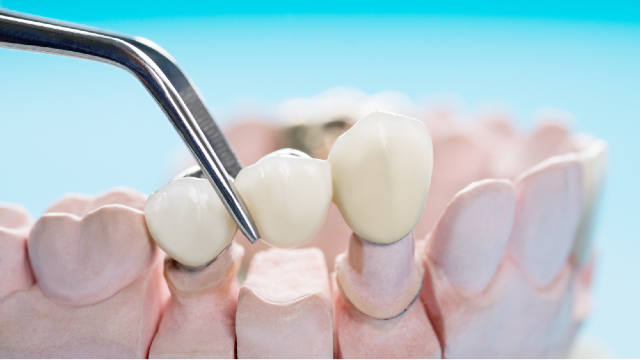
- A traditional bridge relies on adjacent teeth as anchors: A conventional three-unit dental bridge vs implant restoration suspends a replacement tooth between two crowns cemented onto the neighboring teeth, which means a bridge requires shaving adjacent teeth around their circumference.
- The condition of your neighboring teeth can tip the scale: If the teeth next to the gap are cavity-free and structurally sound, an implant protects their natural enamel; however, if those adjacent teeth already have large failing fillings or old crowns that require full-coverage replacement anyway, a bridge can restore the span together.
- Systemic and anatomical factors govern implant eligibility: Patients with severe uncontrolled diabetes, active periodontal disease, heavy tobacco reliance, untreated anterior bone loss, or incomplete jaw growth are not immediate candidates for a front tooth implant and may require foundational care or a non-surgical alternative.
- Long-term upkeep differs in daily mechanics: An implant crown is brushed and flossed like a natural single tooth, whereas a joined three-unit bridge requires threading floss underneath the suspended middle tooth to protect the supporting anchor teeth from root decay.
How Each Option Replaces a Missing Front Tooth
When you explore replace one missing tooth options with a dentist, the two primary fixed (non-removable) solutions are a single-tooth dental implant and a tooth-supported fixed dental prosthesis, commonly called a dental bridge. While both restore a continuous smile line and allow you to bite and speak comfortably, their underlying biomechanics are fundamentally different.
1. The Single-Tooth Front Implant: Root-and-Crown Replacement
A front tooth implant replaces both the visible clinical crown and the unseen root beneath the gumline using three coordinated components:
- The Titanium Implant Fixture: A biocompatible titanium post surgically placed into the anterior jawbone where the natural tooth root once sat. Over the healing period, living bone integrates directly with the titanium surface (osseointegration).
- The Custom Titanium Abutment: A patient-specific connector that passes through the gum tissue, sculpted to support the triangular interdental gum papillae and follow the natural wave of the gumline.
- The Zirconia Implant Crown: A metal-free ceramic crown digitally milled to match the shade, incisal translucency, and proportions of the neighboring front teeth.
Because the titanium fixture is anchored directly in the jawbone, the restoration is self-supporting—an implant independent of neighboring teeth. At Harue Dental Clinic, Dr. Hanna Lee uses 3D imaging, an index-guided placement technique, the Ankylos implant system, and in-house CAD/CAM digital fabrication to plan the implant position, gumline contour, custom titanium abutment, and zirconia crown together.
2. The Traditional Three-Unit Dental Bridge: Crown-Supported Suspension
A conventional fixed dental bridge replaces only the visible portion of the missing tooth above the gumline. Instead of anchoring into the bone, it spans the empty space by relying on the adjacent teeth:
- Two Abutment Crowns (Retainers): The natural teeth immediately to the left and right of the gap are reshaped around their circumference and covered with crowns.
- The Pontic: A solid ceramic replacement tooth is fused permanently between the two outer crowns, resting gently against the surface of the gum ridge where the natural tooth was lost.
Because all three units are fabricated as a single rigid piece and cemented onto the two prepared neighboring teeth, every biting force applied to the middle replacement tooth is carried by the roots of the two adjacent anchor teeth.
Protecting Your Neighboring Teeth: The Core Clinical Difference
For patients who value minimally invasive dentistry, the most important factor in a front tooth implant vs bridge decision is the biological impact on the adjacent teeth on day one—and over the decades that follow.
Why a Bridge Requires Shaving Adjacent Teeth
To seat a conventional three-unit ceramic bridge without making the front teeth look bulky or protrude against the lip, the dentist must remove a substantial layer of outer enamel and underlying dentin from both neighboring teeth. Even when those two neighboring teeth are completely healthy and cavity-free, preparing them as bridge abutments permanently alters them:
- Irreversible Enamel Reduction: Once intact enamel is ground down into crown preparations, that natural tooth structure cannot regenerate. Those two teeth will depend on full-coverage crowns for the rest of the patient's life.
- Pulp and Nerve Stress: Preparing vital front teeth—especially slender upper lateral incisors or lower incisors—exposes microscopic dentinal tubules. While local anesthesia keeps preparation painless, a proportion of prepared abutment teeth can experience pulp inflammation over the years and eventually require root canal treatment.
- Shared Mechanical Load: Two natural roots must now support the biting and forward-gliding guidance forces of three front teeth.
How an Implant Preserves Adjacent Enamel and Independence
Placing a single front tooth implant does not require preparing the enamel of the neighboring teeth. The adjacent incisors or canines keep their intact enamel shell, their natural pulp vitality, and their independent root support.
| Clinical Factor | Single Front Tooth Implant | Traditional 3-Unit Dental Bridge |
|---|---|---|
| Impact on Healthy Neighboring Teeth | None. Adjacent teeth remain untouched and structurally independent. | High. Requires irreversible circumferential tooth reduction on both adjacent teeth. |
| Underlying Jawbone Support | Titanium fixture stimulates internal bone during function, helping maintain ridge volume. | No root sits inside the bone beneath the pontic; gradual ridge resorption can occur over time. |
| Interdental Hygiene & Flossing | Brushed and flossed individually between every tooth, just like natural dentition. | Crowns are fused together; requires floss threaders or interdental brushes under the pontic. |
| Future Complication Scope | If a crown chips or loosens, only the single implant restoration is serviced. | If one supporting tooth develops root decay or endodontic failure, the entire 3-unit bridge is affected. |
| Surgical Requirement | Requires a 60–90 minute outpatient surgical placement under local anesthesia. | Non-surgical prosthetic procedure; no bone surgery required after socket healing. |
| Typical Treatment Timeline | 2 to 3 primary visits over 3 to 6 months for osseointegration (selected cases shorter). | Usually completed within 1 to 2 visits once the extraction socket gum tissue has healed. |
How Long-Term Complications Differ
Long-term systematic reviews comparing single-tooth implant crowns and conventional three-unit fixed partial dentures show that while both achieve strong multi-year survival rates, their failure modes differ markedly.
With a three-unit bridge, the primary biological vulnerability is secondary decay at the crown margin or endodontic failure on one of the supporting natural teeth. Because the three-unit structure is splinted rigidly together, if cement loosens on one anchor tooth while the other stays firm, bacteria can seep underneath undetected. If one supporting tooth eventually fractures or becomes non-restorable, the patient faces a wider multi-tooth gap.
With a single-tooth implant, the titanium fixture and zirconia crown cannot develop tooth decay. While implants require consistent gum care to prevent peri-implant tissue inflammation, any technical issue—such as ceramic chipping or cement loosening—remains isolated to that single tooth without putting the neighboring natural teeth at risk.
Gumline Contour and Bone Preservation in the Smile Zone
When a front tooth root is extracted, the jawbone at that site loses internal mechanical stimulation and naturally narrows over time:
- Under a Bridge Pontic: Because the middle tooth of a bridge rests on top of the gums, the bone underneath can gradually resorb over the years, sometimes opening a small shadow or gap above the pontic in patients with a high smile line.
- Around a Front Tooth Implant: At Harue Dental Clinic, anterior implant planning coordinates the titanium fixture, custom titanium abutment, and zirconia crown to support the bone and gumline architecture together. When 3D imaging confirms sufficient bone volume and density, index-guided placement seats the Ankylos implant fixture directly within the native bone, supporting a natural emergence profile. Examples of anterior restorations can be viewed in the clinic's before and after gallery.
Suitability Criteria: Who Should Choose an Implant vs. a Bridge?
A thorough dental bridge vs implant consultation ties treatment selection directly to your oral anatomy and medical history rather than offering a one-size-fits-all answer. At Harue Dental Clinic—where Dr. Hanna Lee brings 30+ years of clinical experience, graduated second in her class from Pusan National University College of Dentistry in 1994, and placed 90,696 cumulative implants as of September 2025—every candidate undergoes 3D imaging and a clinical examination first.
Harue's Clinical Exclusions: Who Is Not Suitable for an Immediate Front Implant
Harue Dental Clinic lists specific systemic and local conditions that exclude a patient from immediate front tooth implant surgery:
- Severe Uncontrolled Diabetes: Impaired blood sugar control compromises microvascular circulation and bone healing, elevating the risk of infection and failed implant integration.
- Active Periodontal (Gum) Disease: Active bacterial gum inflammation threatens both the new implant surface and the delicate bone peaks supporting the front papillae; gum disease must be treated first.
- Heavy Tobacco Reliance: Heavy smoking constricts gingival blood flow, delays wound healing, and increases implant failure rates.
- Untreated Bone Loss: When trauma or prior infection leaves insufficient anterior bone volume or density to stabilize a fixture, bone augmentation is required before or in coordination with implant placement.
- Incomplete Jaw Growth in Young Patients: Adolescents and young adults whose jaws are still growing should wait until skeletal maturity before receiving a fixed anterior implant, so the implant crown does not end up looking shorter than the erupting natural teeth beside it.
When Single Tooth Implant Alternatives Make Clinical Sense
Evaluating single tooth implant alternatives reveals several situations where a dental bridge or conservative provisional is the right choice:
- The Neighboring Teeth Already Require Full Crowns: If the two teeth next to the gap are heavily decayed, structurally fractured, or covered by old porcelain-fused-to-metal (PFM) crowns showing dark gray gumline margins, crowning them as part of a metal-free zirconia bridge restores all three teeth at once without sacrificing virgin enamel.
- Medical Contraindications to Surgery: Patients who cannot undergo oral surgery or bone grafting for medical reasons can achieve a fixed restoration with a tooth-supported bridge.
- Resin-Bonded Bridge for Growing Patients: Young patients whose jaw growth is incomplete often use a conservative resin-bonded bridge as fixed interim replacement until their facial growth stabilizes for an implant.
Longevity, Daily Upkeep, and Travel Logistics in Seoul
For U.S. patients traveling from Los Angeles, New York, San Francisco, Houston, or Chicago, comparing bridge vs implant longevity, home maintenance, and travel timelines helps clarify the practical commitment required.
Daily Upkeep and Realistic Longevity
- Single Front Tooth Implant: Cleaned with standard twice-daily brushing and normal interdental flossing on either side of the zirconia crown, paired with routine six-month checkups and avoiding biting hard objects (such as ice) with the front teeth.
- Three-Unit Bridge: Requires threading super-floss, a floss threader, or an interdental brush underneath the suspended middle tooth every day to keep the margins of the two supporting anchor teeth clean.
Neither restoration is guaranteed to remain unchanged forever; longevity depends on consistent hygiene, gum and bone health, and individual bite forces.
Travel Schedules at Harue Dental Clinic
Because Harue Dental Clinic has operated an in-house CEREC and CAD/CAM digital laboratory since 2007 under a single-doctor workflow, ceramic restorations are milled in-house without waiting weeks for an outside lab:
- Front Tooth Implant Schedule: Requires two to three primary visits across a three to six month window. Surgical placement takes about 60 to 90 minutes under local anesthesia, and most patients can fly home 2 to 3 days after surgery following Dr. Hanna Lee's postoperative check (selected cases with ideal bone density may support a shortened timeline after individual evaluation). After osseointegration is confirmed, the patient returns for 3D camera scanning and in-house fabrication of the custom titanium abutment and zirconia crown.
- Crown/Bridge Prosthetic Schedule: When no implant surgery or osseointegration window is involved, in-house digital scanning, design, and ceramic milling allow eligible crown restorations to be completed in a single visit or 1 to 2 short visits over 1 to 3 days.
Located at 41-11, Gangnam-daero 162-gil, Gangnam-gu, Seoul (Sinsa-dong, Harue Dental Clinic Building), Harue Dental Clinic is a Ministry of Health and Welfare–registered medical institution for foreign patients and maintains a 19-step infection-control system. Dr. Hanna Lee completed her DDS, MSD, and PhD degrees in implantology at the Catholic University of Korea Graduate School of Dentistry (where she serves as an Adjunct Professor) and completed a clinical implant surgery program at the University of Berlin. You can read patient feedback on the clinic reviews page or arrange a consultation via Harue Dental Clinic's contact page with English-speaking coordinator Jeon Jin-mi (confirm interpreter availability for specific visits in advance).
Frequently Asked Questions
Why does a dental bridge require shaving down the teeth next to a missing front tooth?
A conventional three-unit bridge supports the middle replacement tooth by cementing crowns over the two natural teeth on either side of the space. To create room for the ceramic walls of those anchor crowns without making your front teeth look bulky, the dentist must permanently reduce a layer of outer enamel around both neighboring teeth.
Does a front tooth implant require altering the neighboring teeth?
No. A single-tooth front implant anchors directly into the jawbone where your missing root sat and functions independently of the neighboring teeth. Using 3D imaging and index-guided placement, the fixture is positioned safely away from adjacent roots so healthy neighboring enamel remains untouched.
When is a dental bridge a better option than a front tooth implant?
A bridge makes clinical sense when the two teeth adjacent to the gap already have large failing fillings, structural fractures, or old discolored crowns that need full-coverage crown replacement anyway. It can also serve patients who have medical exclusions to oral surgery or who cannot commit to the multi-month healing window of an implant.
Who is not suitable for an immediate front tooth implant?
Harue Dental Clinic lists severe uncontrolled diabetes, active periodontal disease, heavy tobacco reliance, untreated bone loss, and incomplete jaw growth in young patients as clinical exclusions. Many adult patients can qualify for staged implant treatment once gum disease is treated, blood sugar is managed, or bone grafting is completed.
Which is easier to floss and maintain: a front tooth implant or a bridge?
A single-tooth implant is easier to clean because the zirconia crown emerges individually from its custom titanium abutment, letting you pass regular floss through the contacts normally. A three-unit bridge joins three teeth together, requiring a floss threader or interdental brush every day to clean underneath the suspended middle tooth.
What should I do if I have a concern about my restoration after returning to the U.S.?
Contact Harue Dental Clinic's international coordinator team at +82 2 543 0037, info@haruedentalclinic.com, or via the clinic website for follow-up guidance. If you experience urgent symptoms such as severe pain, persistent bleeding, pronounced swelling, or fever, seek immediate in-person care from a local dentist or emergency medical provider.
This article is for informational purposes only and is not a self-diagnosis tool or a substitute for a clinical examination and personalized treatment plan from a licensed dentist.
More Articles
Continue reading our clinical guides.