Personalized Medical Care & Dedicated International Patient Concierge

Medical Guide
Crown vs Implant: Save or Replace a Damaged Tooth?
Weighing a crown vs implant? Learn whether to save tooth or get implant after root canal or fracture, and when root support calls for replacement in Seoul.
Schedule a ConsultationCrown vs Implant: Save or Replace a Heavily Restored Tooth?
Medically reviewed by Dr. Hanna Lee, DDS, MSD, PhD
Facing a crown vs implant decision usually happens when a tooth has already been through a lot—a deep cavity that reached the nerve, a cracked cusp around an aging filling, or an older cap that has loosened or decayed along its margin. At that crossroads, patients reasonably ask whether it makes more sense to save tooth or get implant treatment right away. Putting another restoration onto a fragile tooth can feel risky if the root might fail a couple of years later, yet extracting a natural root that could still serve comfortably for another decade sacrifices biological structures that no artificial fixture can duplicate.
At Harue Dental Clinic in Sinsa-dong, Gangnam-gu, Seoul (established in 1995), Dr. Hanna Lee—a prosthodontic and implant clinician with more than 30 years of clinical experience since graduating second in her class from Pusan National University College of Dentistry in 1994, and an Adjunct Professor in the Department of Implant Dentistry at The Catholic University of Korea—approaches this dilemma from a clear clinical starting point: natural tooth preservation comes first whenever the underlying root and periodontal foundation are sound. At the same time, a clinician who has placed 90,696 cumulative dental implants and operated an in-house digital CEREC and zirconia prosthetic laboratory since 2007 recognizes that forcing a crown onto an unsalvageable root only costs the patient time, bone volume, and frustration. This guide explains how a dentist evaluates root canal crown vs implant choices, what structural criteria determine whether to extract or restore tooth structure, and how both pathways work when you visit Seoul.
Key Takeaways
The Bottom Line
- Natural roots carry biological advantages worth keeping: A healthy natural tooth root is suspended in the jawbone by the periodontal ligament, which acts as a microscopic shock absorber and pressure sensor during chewing. If a compromised tooth can be predictably stabilized with a crown after root canal therapy, keeping the natural tooth is the primary clinical choice.
- Structural biomechanics—not guesswork—draw the boundary: Choosing among heavily damaged tooth options comes down to ferrule height (the band of sound tooth structure above the gumline), crown-to-root ratio, root wall thickness, crack depth, and periodontal health on 3D imaging.
- Knowing when a tooth cannot be saved protects future implant bone: Repeatedly re-crowning a root with deep subgingival decay or a vertical crack often fuels chronic periapical or periodontal inflammation that erodes the surrounding jawbone needed for a future implant.
- Individualized diagnostics prevent bias toward either extreme: Because Harue Dental Clinic performs both minimally invasive digital ceramic restorations and 3D computer-guided implant surgery in-house, Dr. Hanna Lee evaluates each tooth on its structural prognosis rather than steering every compromised tooth toward extraction or every failing root toward another cap.
Why Natural Tooth Preservation Is the Clinical Starting Point
In modern restorative dentistry, dental implants have achieved high long-term survival rates, leading some patients to view extraction and implant placement as a shortcut around the uncertainties of a heavily restored tooth. Yet clinical guidelines published in peer-reviewed literature indexed in PubMed by the National Library of Medicine, including an analysis of clinical guideline and treatment planning decisions of single-tooth implants versus preserving natural teeth, emphasize that implants are designed to replace missing or non-restorable teeth, not teeth that can be predictably rehabilitated.
Dr. Hanna Lee's treatment philosophy at Harue Dental Clinic centers on preserving natural teeth and healthy enamel/dentin wherever biomechanically reasonable, supported by her 2011 Korean patent for minimally damaging tooth design and her clinical lecturing in computerized ceramic restorations. Preserving a natural tooth with a well-fitted all-ceramic or zirconia crown offers three physiological benefits over extraction:
- Retention of the Periodontal Ligament (PDL): A natural tooth root connects to the alveolar bone through collagen fibers and mechanoreceptors. This ligament provides tactile sensitivity and cushions heavy occlusal loads. A dental implant fuses directly to bone through osseointegration, meaning it lacks a periodontal ligament and transmits chewing forces directly into the bone and opposing teeth.
- Preservation of Natural Gingival Architecture: The interdental papillae (the small triangles of gum tissue between teeth) are supported by connective tissue fibers inserting into the natural root cementum above the bone crest. Particularly in the front zone, keeping the natural root helps maintain soft-tissue contours naturally.
- Non-Surgical Turnaround When the Root Is Stable: If a tooth already has a healthy, symptom-free root or only requires core build-up and cuspal protection, restoring it with a crown avoids surgical extraction and multi-month healing windows. Furthermore, a university-based qualitative study indexed on PubMed examining the quality of life of endodontically treated versus implant treated patients noted that patients value keeping their natural dentition when treatment restores comfortable chewing function.
What Each Option Actually Does: Crown vs. Dental Implant
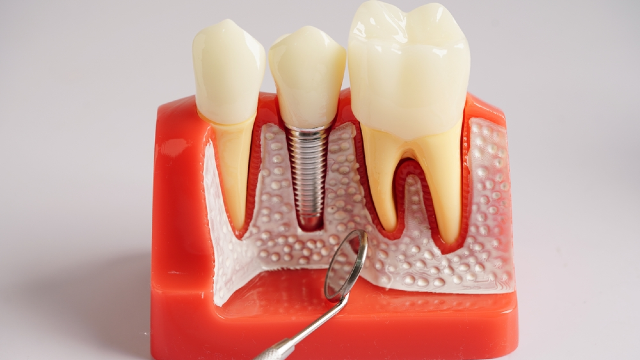
To weigh crown vs implant options clearly, it helps to separate what happens above the gumline from what happens inside the bone. Both treatments end with a custom-milled, tooth-colored ceramic crown visible in your smile, but the foundation supporting that crown is entirely different.
Option A: Saving the Tooth With a Full-Coverage Crown
A dental crown is a 360-degree protective restoration that encases the prepared coronal portion of your natural tooth, relying on your existing natural root for anchorage.
- When a tooth needs a crown alone: If a tooth has lost substantial enamel and dentin to a large cavity, a fractured cusp, or an aging filling—but the inner pulp (nerve) remains healthy—the dentist removes the decayed or weakened structure, builds up the inner core, prepares the outer walls (typically a conservative
0.5 to 1.0 mmreduction for all-ceramic zirconia crowns at Harue Dental Clinic), and bonds a custom ceramic crown over the natural tooth. - When a tooth needs a root canal plus a crown (
root canal crown vs implant): If deep decay or a crack has caused irreversible inflammation or infection inside the pulp, endodontic (root canal) therapy is performed first to disinfect and seal the internal canals. Because a root-canal-treated premolar or molar is hollowed out centrally, leaving it with a simple filling exposes the remaining walls to wedging forces that can split the tooth. Placing a full-coverage crown after root canal treatment binds the cusps together. Research indexed by the National Library of Medicine on the survival and success rate of restoration post endodontic treatment confirms that timely coronal coverage is one of the strongest predictors of long-term survival for endodontically treated teeth.
Option B: Extracting the Tooth and Replacing It With a Dental Implant
A dental implant is a complete root-and-crown replacement system used when the natural tooth root is missing, fractured beyond repair, or structurally incapable of supporting a prosthesis. An implant restoration consists of three engineered components:
- The Titanium Implant Fixture (Artificial Root): A biocompatible titanium post placed into the jawbone. At Harue Dental Clinic, Dr. Hanna Lee—an Asian advisor for the German Ankylos implant system and Research Advisor for Osstem Implant—uses 3D cone-beam CT imaging and computer-guided navigation (or index-guided) protocols to position the fixture at the planned angle and depth relative to nerves, sinus cavities, and adjacent roots.
- The Custom Titanium Abutment (Connector): Rather than relying on generic stock abutments, Harue Dental Clinic designs and mills custom titanium abutments tailored to the patient's gumline emergence profile and bite vector.
- The Zirconia Implant Crown: A metal-free, high-strength zirconia crown fabricated in the clinic's on-site digital dental laboratory is secured to the custom abutment to restore chewing function and aesthetics.
Side-by-Side Comparison: Saving a Tooth With a Crown vs. Replacing With an Implant
When evaluating heavily damaged tooth options, comparing the biological, mechanical, and logistical trade-offs side by side clarifies what each pathway involves:
| Decision Factor | Restoring the Natural Tooth With a Crown | Replacing the Tooth With a Dental Implant |
|---|---|---|
| Underlying Support | Uses your natural tooth root and periodontal ligament in alveolar bone | Replaces the root with an osseointegrated titanium implant fixture |
| Primary Indication | Significant coronal decay, fracture, wear, or root canal treatment with sound root support | Tooth is missing, vertically fractured, decayed deep below the gumline, or lacks root support |
| Bite Sensation | Preserves natural periodontal ligament nerve fibers for tactile feedback | Solid bone-to-implant connection without a ligament shock absorber |
| Future Biological Risk | Natural tooth margin at the gumline can develop recurrent caries if plaque collects | Cannot decay, though surrounding gum and bone require hygiene to prevent peri-implantitis |
| Timeline at Harue | Same-day completion (a few hours) for eligible CEREC crowns, or 1 to 3 days / 1 to 2 weeks |
Typically 2 to 3 primary visits across 3 to 6 months (selected cases qualify for immediate protocols) |
| Surgical Requirement | Non-surgical prosthetic preparation under local anesthesia | Requires tooth extraction and surgical implant placement (plus grafting if bone is deficient) |
| Expected Service Life | All-ceramic crowns average 10 to 15 years and can exceed 20 years with proper care |
Engineered as a long-term root replacement when bone integration and hygiene are maintained |
The Structural Tipping Point: When a Tooth Can Be Saved vs. When It Cannot
In Harue Dental Clinic's clinical guidelines for all-ceramic crowns, same-day CEREC crowns, zirconia crowns, and crown replacements, Dr. Hanna Lee evaluates four anatomical thresholds to decide whether to extract or restore tooth structure.
1. The Ferrule Effect: Sound Tooth Structure Above the Gumline
In prosthodontics, the ferrule is a 360-degree collar of unbroken natural dentin extending at least 1.5 to 2.0 millimeters above the gumline margin. When a crown wraps around this collar, it braces the tooth like a metal band around a barrel, preventing the root from splitting under chewing loads.
When extensive structural decay or fracture extends deep below the gumline or down to the bone crest, the crown has no sound collar of tooth structure to grip. Clamping a crown onto a flat root face with a canal post acts like a wedge inside the root, frequently leading to root fracture or debonding. Biomechanical research indexed in PubMed by the National Library of Medicine evaluating the effect of different ferrule heights and crown-to-root ratios on fracture resistance of endodontically-treated mandibular premolars demonstrates that inadequate ferrule height combined with an unfavorable crown-to-root ratio significantly reduces fracture resistance.
2. Crack Depth: Coronal Craze vs. Vertical Root Fracture
- Restorable cracks: If a crack is confined to the coronal enamel and dentin above the gumline or stops above the pulp chamber floor, binding the cusps under a full-coverage ceramic or zirconia crown prevents the segments from flexing apart. A systematic review and meta-analysis on PubMed examining the outcomes of endodontically treated cracked teeth found favorable survival rates when cracked teeth receive root canal therapy followed promptly by full-coverage crown protection.
- Non-restorable fractures (
when a tooth cannot be saved): If 3D CT imaging or microscopic inspection reveals a vertical root fracture extending lengthwise down the root below the bone level, neither a crown nor a root canal can seal the split. Bacteria colonizing the crack erode the adjacent bone plate, making prompt extraction and implant planning the safer choice.
3. Remaining Root Support and Periodontal Health
Harue Dental Clinic's suitability guidelines explicitly state that patients with insufficient remaining natural tooth root support or severe unmanaged active periodontal disease require foundational treatment or dental implants rather than immediate crown replacement. If bone loss or prior root-end surgery has left a short, mobile root with an unfavorable crown-to-root ratio, placing a new crown will not stabilize the tooth.
4. Endodontic Retreatment Prognosis (implant after failed crown)
When an existing crown after root canal treatment fails years later due to recurrent decay or a root-tip infection, Dr. Lee inspects the underlying stump after removing the old cap. If the root walls remain thick and a solid ferrule exists, endodontic retreatment and a new crown may save the tooth. However, if the root has a perforation, paper-thin canal walls weakened by a large post, or persistent pathology after prior retreatment, transitioning to an implant after failed crown removal provides a more predictable foundation.
How Harue Dental Clinic Executes Both Pathways in Seoul
Because Harue Dental Clinic's clinical team houses both an on-site CAD/CAM ceramic laboratory (operating since 2007 with 17 intraoral 3D scanners—5 PrimeScans and 12 Omnicams—and 24 milling machines) and a 3D navigation-guided implant center, patients receive a unified diagnostic workup.
Pathway 1: Saving the Tooth With an In-House Ceramic Crown
- Conservative Preparation: Decayed tissue or a failing old crown is removed under local anesthesia while preserving sound dentin.
- Optical 3D Scanning: A digital intraoral camera captures the prepared tooth and bite without messy putty impressions.
- In-House CAD/CAM Milling: Eligible Same-Day CEREC Crowns are milled from a ceramic block with a stated strength of approximately
150 MPa(matching natural enamel wear and stronger than conventional porcelain at roughly80 MPa), glazed, and bonded in one visit lasting a few hours. For heavy molar loads or darkened root stumps, All-Ceramic Zirconia Crowns are milled in-house, sintered, and refined chairside by Dr. Lee.
Pathway 2: Replacing the Tooth With a Navigation-Guided Implant
- Atraumatic Extraction: The non-restorable root is removed carefully to preserve socket bone. As outlined in an International Team for Implantology consensus report indexed on PubMed on the management of the extraction socket and timing of implant placement, immediate vs. staged placement is chosen based on socket wall integrity, infection status, and primary stability.
- 3D Navigation-Guided Placement: Having introduced navigation-guided implant surgery in 2002 (registered as "Navigation Implant" in 2007), Harue Dental Clinic uses 3D CT planning to place the titanium fixture (such as the Ankylos system) at the planned angle and depth. Where bone volume and density are sufficient on 3D imaging, guided planning may reduce or avoid bone grafting; if bone is deficient, grafting and staged healing come first.
- Custom Titanium Abutment and Zirconia Crown: After osseointegration, a custom titanium abutment and an in-house zirconia crown are delivered. Clinical examples can be viewed in the clinic's before-and-after gallery.
Risks, Limitations, and Travel Timelines for International Patients
- Risks to weigh: Restoring a borderline tooth with a crown carries risks of temporary thermal sensitivity, ceramic chipping under bruxism, or delayed root fracture if hidden micro-cracks progress. Implant surgery involves minor post-operative swelling, bruising, or discomfort, requires
3 to 6 monthsof healing when staged, and demands ongoing plaque control and nightguard protection. - Stay duration in Seoul: Eligible same-day CEREC crowns take a single visit of a few hours (
1 to 3 daysrecommended stay in Korea), while multi-step zirconia crowns or root canal + crown cases typically span1 to 2 weeks. Standard implant treatment requires2 to 3 primary visitsover3 to 6 months, though selected front-tooth cases with strong bone density may qualify for same-day implant and provisional prosthetic protocols.
What to Confirm With the Clinic
Before booking travel via the Harue Dental Clinic contact page, confirm these five details:
- Pre-Travel X-Ray Review: Email recent X-rays to
info@haruedentalclinic.comso Dr. Hanna Lee can provide a preliminary assessment of whether your tooth appears restorable or likely requires extraction. - Remaining Ferrule Assessment: Ask the dentist to show you on the 3D scan and radiograph how much sound tooth wall remains above the bone crest once old restorations or decay are removed.
- Schedule Contingency: Ask how your stay timeline adjusts if removing an old crown reveals a deep subgingival crack requiring extraction and staged implant care.
- Implant & Abutment Specifications: If an implant is needed, confirm the fixture system (such as the Ankylos titanium implant system), whether bone grafting is anticipated on 3D CT, and the custom titanium abutment + in-house zirconia crown workflow.
- Coordinator Availability: Harue Dental Clinic is open Monday–Friday
09:00 AM–17:25 PM KSTand Saturday08:30 AM–12:30 PM KSTby reservation. Call+82 2 543 0037or+1 208-825-7756to confirm an English-speaking coordinator (such as Jeon Jin-mi) in advance.
Frequently Asked Questions
Is it better to save a tooth with a root canal and crown or pull it and get an implant?
When a tooth has an intact root, healthy bone, and at least 1.5 to 2.0 mm of sound tooth wall above the gumline (the ferrule), saving the natural tooth with root canal therapy and a full-coverage ceramic crown is preferred because it retains your periodontal ligament and natural bite sensation. An implant becomes the smarter choice when the root is cracked below the bone, decayed deep beneath the gumline, or lacks adequate bone support.
When is a heavily damaged tooth beyond saving with a crown?
In Harue Dental Clinic's guidelines, when a tooth cannot be saved typically involves decay or fracture extending deep below the gumline where a crown cannot seal on sound dentin, a vertical root fracture splitting the root lengthwise, severe unmanaged periodontal disease causing mobility, or an unfavorable crown-to-root ratio with insufficient root support.
How long does a crown after root canal last compared to a dental implant?
All-ceramic and zirconia crowns average 10 to 15 years and can last more than 20 years with a healthy root, balanced bite contacts, and daily hygiene. A dental implant fixture integrated into bone is engineered as a long-term root replacement, though its zirconia crown and surrounding gum tissue still require routine hygiene and nightguard protection if you grind.
What happens if an old crown fails—do I need an implant after a failed crown?
Not necessarily. Once Dr. Hanna Lee removes the old crown, she inspects the underlying natural tooth stump. If the root is uncracked and enough healthy dentin remains above the gumline, a new all-ceramic zirconia or CEREC crown can be fabricated. If deep recurrent decay has hollowed out the root below the gumline, transitioning to an implant after failed crown removal is recommended.
Can I switch from a planned crown to an implant during the same trip to Seoul if the tooth is cracked underneath?
If removing an old opaque crown reveals a non-restorable subgingival crack, extraction (and, where bone volume and infection status permit, guided implant placement or socket grafting) can typically be started during the same visit window, though final implant crown delivery usually follows a 3 to 6 month healing period.
This article is for informational purposes only and is not a self-diagnosis tool or a substitute for a clinical examination and personalized treatment plan from a licensed dentist.
More Articles
Continue reading our clinical guides.